| HOME | CRASH SITES | ABOUT US | CONTACT US | LINKS | DOLWEN LANCASTER | ROB'S CLASSIC SPRAYERS BUSINESS |

8. HAUGHMOND MOSQUITO
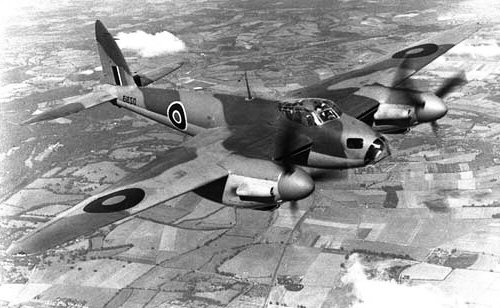
On the night of 9th November, 1944, Mosquito NF Il, DZ 244, of 60 Operational Training Unit, High Ercall, took off for an exercise in circuits and landings. The Pilot, Flying Officer Feliks Pawel Nowak, was flying solo on night fighter conversion training. At around 1am, just after his sixth take-off, the Mosquito veered into a sharp turn in the circuit area and went into a spiral dive before crashing vertically and exploding on impact at Haughmond Farm, near Shrewsbury. The cause of the crash points to engine failure at low speed. A report from the Aeroplane and Armament Establishment at Boscombe Down indicates that during a test flight in a Mosquito, the pilot was carrying out an asymmetric test at critical speeds when the starboard engine cut out at 32,500 feet. The aircraft had then swung immediately to the right and entered a dive. At 25,000 feet, at an airspeed of about four hundred miles an hour, control was lost, only to be regained at 21,500 feet, following a loss of 11,000 feet. A former Mosquito navigator at High Ercall has recalled that failure of one engine could be difficult for a pilot to handle. At low altitude, there would have been little chance for Flying Officer Nowak to keep control, although he was considered to be a competent pilot, with over five hundred flying hours experience on aircraft including Tiger Moths and Oxfords. After service with the Polish army from 1937 to 1938, he became a cotton expert until Germany invaded Poland, when he saw much fighting with the 59th Infantry Regiment. Escaping from Poland via Hungary and Yugoslavia to France, he once again joined the Polish forces, under French control. At some time during this period, it appears that he became a prisoner of war, but little is known of his life until he made his way to England via France, Spain and Portugal, when he joined the Polish aircrew training centre at Hucknall, Derbyshire, in July, 1942. On September 1st 1943, he was commissioned as Pilot Officer and posted to High Ercall on October 17th 1944. A few weeks later, his life was to end. Several years ago, a lady visited Haughmond Farm with her daughter. She was Delphing Nowak, the wife of Feliks. Sadly, Feliks had not been destined to see his beloved Poland or his daughter when he died at the age of twenty eight. When the Mosquito crashed, wreckage was spread over a wide area, with burning debris landing on the front yard of the farm, only forty yards from the impact point. On the other side of the field a main wheel landed in a garden. Apparently, no damage was caused to any of the nearby buildings. A visit to the site today indicates very little of the accident, although a detailed search reveals small scattered fragments of the Mosquito. The field has never been ploughed due to its rocky surface. Some years ago, members of the Shropshire-based Wartime Aircraft Recovery Group made a shallow excavation at the site before reaching compact shale through which the wreckage had not penetrated. Items found included engine remains, burnt wood, light alloy fragments and a small bracket bearing the Mosquito part number prefix, 98, and a De Havilland inspection stamp. |